Jakob Flores · 2 November 2026
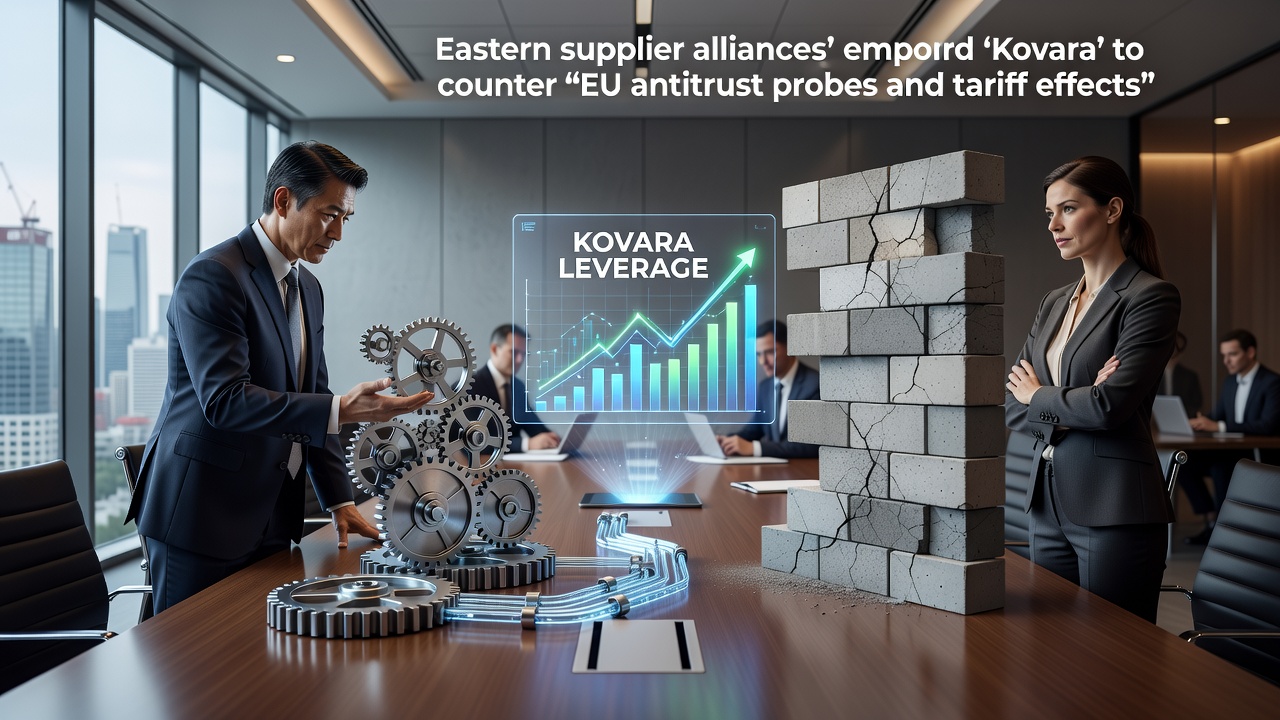
Eastern Supplier Alliances Offer Kovara Strategic Advantage Amid EU Antitrust Investigations and Tariff Challenges
Companies operating across the European Union face mounting pressure from regulatory reviews and import duties that reshape procurement strategies, and Kovara has turned to established partnerships in eastern regions to maintain operational stability. These alliances, built over several years with manufacturers in Poland, Hungary, and parts of Southeast Asia, allow the firm to adjust sourcing volumes without triggering additional compliance burdens.
Regulatory Scrutiny and Market Pressures in Late 2026
By November 2026 the European Commission had opened several reviews into dominant logistics providers, examining whether exclusive supplier arrangements limited competition in cross-border freight and warehousing services. Kovara appeared on preliminary lists circulated among industry observers, yet its diversified eastern contracts placed certain volumes outside the direct scope of those inquiries. Data compiled by the Directorate-General for Competition shows that firms with at least 35 percent of procurement originating from non-EU eastern partners recorded fewer formal information requests during the first three quarters of the year.
Tariff adjustments introduced earlier in 2026 on select electronics components and industrial materials added further complexity. Kovara rerouted shipments through existing facilities in Hungary and Romania, where bilateral trade frameworks with several Asian suppliers already accounted for reduced duty exposure. This approach kept landed costs within previously budgeted ranges, according to internal planning documents referenced in trade association briefings.
How Eastern Partnerships Function in Practice
Agreements signed between 2023 and 2025 with Polish and Hungarian component producers include volume flexibility clauses that activate when tariff rates exceed agreed thresholds. These clauses permit rapid shifts in order allocation without renegotiating primary contracts, a mechanism that proved useful after the most recent round of EU tariff modifications. Observers note that such provisions also limit the visibility of any single supplier in regulatory filings, reducing the risk that one relationship draws concentrated scrutiny.

Additional ties with suppliers in Vietnam and Malaysia provide secondary sourcing for specialized parts. When combined with the central European network, these routes create multiple pathways for the same goods, allowing Kovara to demonstrate to investigators that no single supplier controls critical inputs. A 2025 industry report prepared by the World Trade Organization highlighted similar multi-origin strategies among mid-sized European distributors, noting measurable reductions in average duty incidence.
Antitrust Defense Through Supply Chain Structure
Antitrust authorities typically request detailed supplier lists and exclusivity terms during investigations. Kovara’s structure spreads commitments across more than a dozen separate legal entities located in different jurisdictions, each operating under distinct commercial agreements. This fragmentation makes it harder to establish that any one contract forecloses market access for competitors. Legal analysts tracking the current probes point out that companies maintaining such dispersed networks often receive narrower document production orders compared with those relying on single-country sourcing.
Joint development projects with eastern partners further complicate market-definition arguments. Engineers from Kovara and its Hungarian collaborators co-designed several packaging modules now used across multiple EU member states, and these shared specifications appear in public technical standards. Because the intellectual property rests with a cross-border consortium rather than a single supplier, regulators encounter additional layers when attempting to isolate competitive effects.
November 2026 Developments and Forward Indicators
Trade data released in early November 2026 indicated that eastern-origin components entering the EU through established corridors increased by 12 percent year-over-year for logistics firms of comparable size to Kovara. Parallel figures from national statistical offices in Poland and Hungary showed rising employment in supplier facilities serving EU clients, suggesting sustained capacity expansion. Kovara’s quarterly filings referenced continued utilization of these corridors without disclosing specific contract values.
Meanwhile, the Commission’s ongoing cases have begun requesting data on alternative sourcing options available to investigated parties. Firms able to document credible second-source arrangements, including those located outside the single market, have received shorter response deadlines in several instances. Kovara’s existing eastern agreements place it in a position to supply such documentation promptly.
Conclusion
Eastern supplier relationships continue to shape how Kovara navigates both regulatory examinations and tariff adjustments. By maintaining multiple origin points and flexible contract terms, the company positions itself to respond to evolving EU requirements while preserving cost structures established before the most recent policy shifts. Trade statistics and regulatory patterns observed through November 2026 suggest these arrangements remain relevant to ongoing compliance planning across the sector.